
Different Types Of Acne Scars
Last updated on March 20, 2026
Acne can affect the skin in different ways, and for some individuals, the marks left behind may persist long after active breakouts have settled. The types of acne scars that develop depend on how the skin responds during the healing process. Understanding the different types of acne scars is an important first step in determining whether professional assessment may be appropriate.
Acne scarring is not uniform. Some scars appear as depressions in the skin, while others are raised or thickened. Each acne scar type reflects a different pattern of collagen disruption within the dermis, which is why accurate identification matters.
Why Do Acne Scars Form?
Acne scars develop when inflammation extends deeper into the skin and affects normal tissue repair. During healing, the body produces collagen to rebuild damaged tissue. When collagen production is balanced, the skin surface may return to its usual texture. However, when collagen production is either insufficient or excessive, permanent structural changes can occur.
If too little collagen is produced, the result is a depressed or atrophic acne scar. If too much collagen is produced, a raised scar, such as a hypertrophic or keloid scar may form. Genetics, skin type, severity of inflammation and delayed treatment can all influence how the skin heals.
The Main Types Of Acne Scars
Ice Pick Scars
Ice pick scars are narrow, deep and sharply defined. They often appear as small puncture-like indentations that extend into deeper layers of the skin. Because of their depth, they can be more noticeable under certain lighting and may not respond to superficial resurfacing approaches alone.
Ice pick scars are considered one of the more challenging types of acne scars due to how deeply they extend into the dermis. Management often focuses on treatments that support deeper collagen remodelling. Laser treatment may be considered in appropriate cases to target deeper tissue layers and support gradual structural improvement under professional supervision.
Boxcar Scars
Boxcar scars are broader depressions with clearly defined edges. They may be shallow or deep and are commonly found on the cheeks and temples. Unlike ice pick scars, boxcar scars have a wider base and a more angular appearance.
Shallow boxcar scars may respond to resurfacing approaches that aim to improve surface texture and collagen stimulation. Depending on depth and skin characteristics, laser treatment or RF microneedling may be considered as part of a structured management plan to support gradual textural refinement.
Rolling Scars
Rolling scars create a soft, wave-like appearance across the skin. Instead of sharp edges, these scars cause uneven texture due to fibrous bands beneath the surface that tether the skin downward. This gives the skin a gently undulating look rather than distinct depressions.
As rolling scars involve changes beneath the skin surface, management may focus on treatments that stimulate collagen and improve overall skin texture. RF microneedling or Dermapen microneedling may be considered in suitable individuals to support controlled tissue remodelling over time.
Hypertrophic Acne Scars
Hypertrophic acne scars are raised, firm scars that remain confined to the original area of inflammation. They develop when excess collagen is produced during healing, but do not extend beyond the boundaries of the initial lesion.
Management of hypertrophic scars typically focuses on moderating scar thickness and supporting more stable scar behaviour. Laser treatment may be used in selected cases to address redness and surface irregularities, with careful parameter selection to minimise overstimulation of scar-prone tissue.
Keloid Acne Scars
Keloid acne scars are raised and extend beyond the original wound margins. They may continue to enlarge over time and are considered a chronic form of abnormal scarring. Keloids can vary in firmness, colour and sensitivity and may behave unpredictably.
As keloid scars reflect an overactive healing response, management requires careful clinical assessment. Treatment selection may involve conservative laser-based approaches aimed at moderating scar characteristics while prioritising skin tolerance and long-term stability.
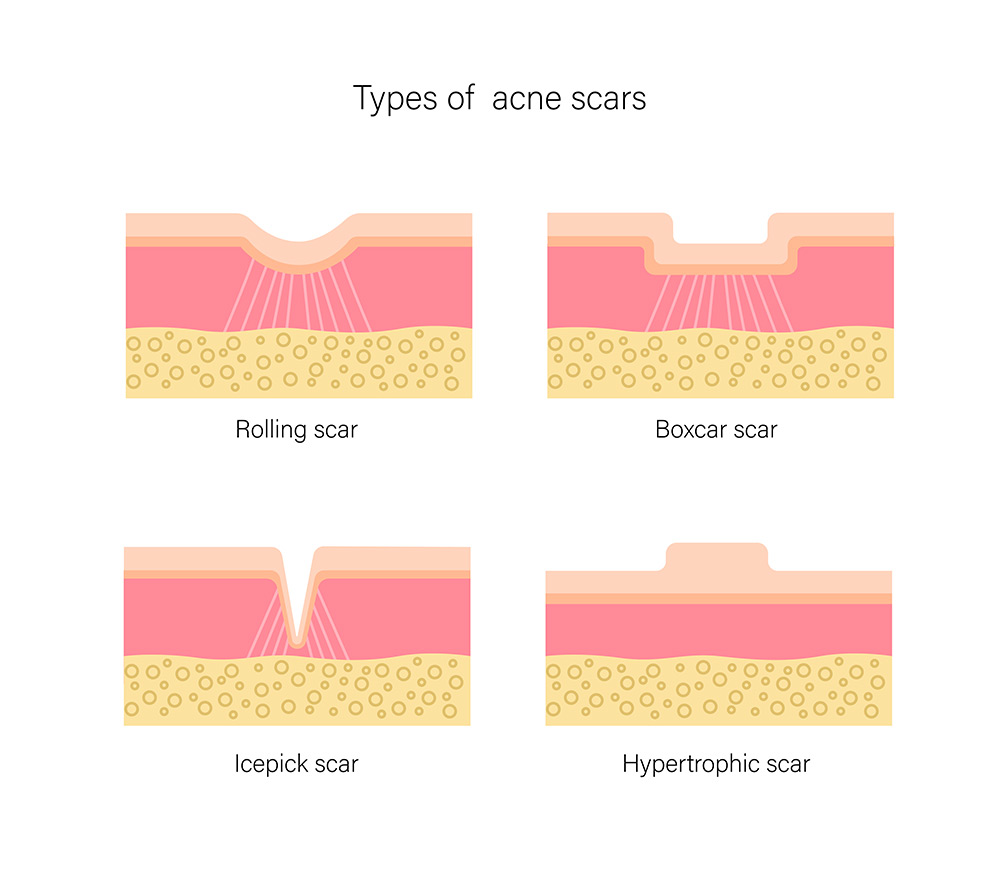
Different types of acne scars can appear as deep indentations, broad depressions or raised scar tissue.
Acne Marks vs Acne Scars
It is common to confuse acne marks with acne scars. Post-inflammatory redness and post-inflammatory hyperpigmentation are not true scars. These changes involve pigment or vascular alterations rather than structural damage to collagen.
True acne scars involve permanent changes in skin texture. They create depressions or raised areas due to altered collagen production. Distinguishing between acne marks and structural acne scars helps guide appropriate next steps and prevents unnecessary intervention.
Can You Have More Than One Type Of Acne Scar?
Most individuals do not present with a single acne scar type. It is common to see a combination of ice pick scars, boxcar scars and rolling scars in the same area. Raised scars may also develop alongside depressed scars, particularly in individuals prone to abnormal healing.
As acne scar patterns can be mixed, professional evaluation helps determine which scar types are present and whether a combination approach may be considered. Management is typically individualised rather than based on a single technique.
Final Thoughts
The different types of acne scars, including ice pick, boxcar, rolling, hypertrophic and keloid scars, each reflect a distinct healing pattern within the skin. Recognising these differences helps clarify why acne scars do not respond uniformly to the same approach.
If you are unsure which acne scar types you have, Prophile Clinics can provide a professional assessment to evaluate scar patterns and discuss whether structured management may be appropriate for your skin. Contact us today to arrange a consultation and receive guidance tailored to your individual presentation.
How to book an appointment
To book an appointment, please call us on +61485 960 001, email us at admin@prophileclinics.com.au, or book online via our website.
FAQs
How Do I Know What Type Of Acne Scars I Have?
Identifying the type of acne scars you have usually requires close examination of scar depth, shape and texture. A professional skin assessment can help distinguish between ice pick, boxcar, rolling, hypertrophic and keloid scars and determine whether structural scarring or pigmentation is present.
Which Types Of Acne Scars Are Hardest To Treat?
Deeper atrophic scars, such as ice pick scars, are often considered more challenging because they extend further into the dermis. Raised scars such as keloids may also require careful management due to their tendency to remain active or recur over time.
What Is The Difference Between Boxcar And Rolling Scars?
Boxcar scars have clearly defined edges and a more angular appearance, while rolling scars create a softer, wave-like texture due to tethering beneath the skin. The distinction is important because their underlying structure differs.
Do Acne Scars Get Worse Over Time?
Acne scars themselves do not usually worsen once fully matured, but changes in collagen and skin elasticity over time may make them appear more noticeable. Raised scars such as keloids may continue to evolve, particularly if they remain active.
Are Acne Scars Permanent?
True acne scars involve structural changes to the skin and are generally considered long-term. While they may not resolve on their own, professional management may help improve their appearance and support a more stable skin texture over time.




 Online Marketing For Doctors

