

How to Repair Your Skin Barrier and Support Hydration
Last updated on October 6, 2026
Skin doesn’t repair its barrier through a product alone. The skin barrier repairs itself, and a well-chosen routine works by reducing avoidable irritation and giving that natural process the conditions it needs, rather than “repairing” anything directly. Understood this way, the most effective approach is often a simpler routine the skin can tolerate consistently, not a longer one.
Skin can become tight, flaky or unusually sensitive even when no single product has recently changed. Irritation may build gradually, particularly when exfoliants, active ingredients and frequent cleansing are combined within the same routine.
The aim is not to introduce numerous “repair” products, but to create a simpler routine that supports the skin’s own barrier function.
What Is the Skin Barrier?
The skin barrier is the protective outer layer of the skin, known as the stratum corneum. It is made up of skin cells held together by natural lipids, including ceramides, cholesterol and fatty acids. Its role is to retain moisture while helping protect the skin from irritants, allergens and microorganisms. When the barrier is disrupted, moisture escapes more easily, and the skin may become dry, tight or unusually reactive.
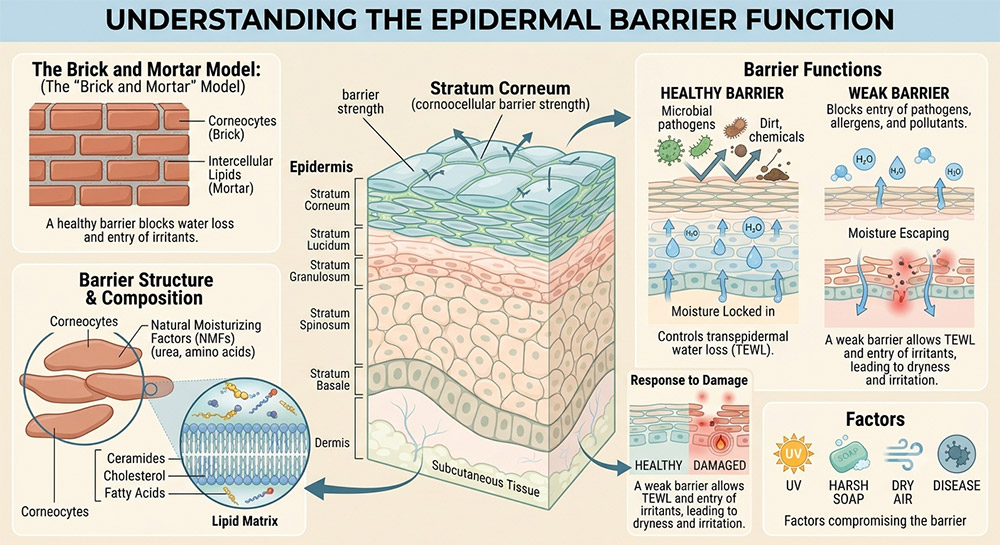
The stratum corneum and its surrounding lipids help limit water loss and protect the skin from external irritants.
Signs the Skin Barrier May Be Disrupted
Barrier disruption can look and feel different from one person to another. Some people notice persistent dryness, while others first become aware of stinging, redness or difficulty tolerating products that previously felt comfortable.
Possible signs of barrier disruption include:
- Tightness that returns soon after moisturising
- Dry, rough or flaky areas of skin
- Stinging when familiar products are applied
- Increased redness or sensitivity
- Itching or general discomfort
- Greater reactivity after cleansing
- Difficulty tolerating active skincare ingredients
What Can Disrupt the Skin Barrier?
Barrier problems often develop through repeated exposure rather than one dramatic event. Product strength, frequency and the number of active ingredients being combined can all matter, particularly when the skin is given little time to adapt.
Potential sources of disruption include:
- Excessive exfoliation
- Frequent use of poorly tolerated active ingredients
- Harsh or repeated cleansing
- Very hot water
- Scrubs and abrasive cleansing tools
- Low humidity, wind and prolonged air conditioning
- Irritant or allergic reactions to individual ingredients
- Ultraviolet exposure
How to Repair the Skin Barrier: Four Practical Steps
Supporting recovery does not necessarily require replacing an entire skincare routine. The priority is to remove likely sources of irritation and maintain a small number of products that the skin can tolerate.
Step 1: Pause Potential Irritants
Temporarily reducing exfoliating acids, retinoids, scrubs and other products that sting can prevent repeated disruption. This does not mean every active ingredient is harmful, but irritated skin may tolerate less than it normally would.
Step 2: Cleanse Gently
Cleansing should remove sunscreen, makeup and surface debris without leaving the skin persistently tight or uncomfortable. Very hot water, repeated cleansing and vigorous rubbing can add irritation without making the skin meaningfully cleaner.
Step 3: Support Moisture Retention
A suitable moisturiser can reduce water loss and support the stratum corneum while it recovers. Formulations may combine humectants that attract water, emollients that smooth the surface and occlusive ingredients that limit evaporation.
Step 4: Protect the Skin From Further Exposure
Broad-spectrum sun protection helps reduce additional ultraviolet stress while the skin is reactive. Wind, low humidity, air conditioning and abrupt temperature changes may also increase dryness, so the surrounding environment can influence recovery.

A simplified routine can make it easier to identify products that may be prolonging irritation.
How Long Does Skin Barrier Recovery Take?
Mild irritation often settles within days to a couple of weeks once the trigger is removed, while repeated disruption or an underlying inflammatory condition can take considerably longer. There is no single timeframe that applies to everyone, since the extent and cause of disruption vary from person to person.
Progress is better judged through reduced tightness, stinging, flaking and reactivity than through an exact number of days. Products should be reintroduced individually and gradually once the skin has remained comfortable, making any renewed reaction easier to identify.
Can Professional Treatment Support Skin Barrier Recovery?
Professional treatment is not automatically appropriate when the skin barrier is acutely irritated. The first step is to identify what has disrupted the skin and determine whether the symptoms are related to product irritation, dryness, dehydration or an underlying condition. In some cases, the skin may need time to settle before any skin-renewal treatment is considered.
At Prophile Clinics, professional support may include hydration-focused care, barrier-supportive skincare recommendations, skin-quality treatments or a gradual skin-renewal approach where suitable. The appropriate plan depends on the condition of the skin, its current sensitivity and how it responds over time. Not every case will require a procedure
When Irritation May Be More Than Barrier Disruption
Severe pain, swelling, blistering, oozing, crusting, rapidly spreading redness, or possible signs of infection require medical advice. Persistent itching, recurring facial rashes and irritation around the eyes may also indicate something other than a temporarily weakened barrier.
Eczema, rosacea, allergic contact dermatitis and irritant contact dermatitis can overlap with signs attributed to barrier damage. Assessment is appropriate when symptoms continue despite a simplified routine, repeatedly return or make it difficult to tolerate basic skincare.
Key Takeaways: How to Repair Your Skin Barrier
- Supporting the skin barrier generally involves removing repeated disruption, limiting water loss and maintaining a routine the skin can tolerate.
- Once the skin remains consistently comfortable, products can be reintroduced gradually so any renewed irritation is easier to identify.
- Distinguishing temporary barrier disruption from an underlying condition helps determine whether professional treatment or a different approach is needed.
At Prophile Clinics, we consider when symptoms began, which products were being used and whether an underlying skin condition may be involved.
How to Book an Appointment
To book an appointment, please call 0485 960 001, email us at admin@prophileclinics.com.au, or book online via the form below.
Frequently Asked Questions About Skin Barrier Repair
Can retinoids damage the skin barrier?
Retinoids can cause dryness and irritation, particularly when first introduced or used too frequently. This does not mean they permanently damage the barrier, but their use may need to be reduced or paused if significant irritation develops.
Can exfoliating acids weaken the skin barrier?
AHAs and BHAs can contribute to barrier disruption when used too frequently, at an unsuitable strength or alongside other irritating products. Individual tolerance varies, so frequency should not be determined by a universal routine.
Should all active ingredients be stopped during barrier recovery?
A temporary pause is often helpful when active products sting or appear to worsen symptoms. Prescribed treatments should be discussed with the prescribing clinician rather than stopped without advice.
Can the skin barrier repair itself?
The epidermis continually renews and can restore normal barrier function when ongoing disruption is removed. Supportive skincare may assist this process, but persistent symptoms can indicate another condition is interfering with recovery.
Why does moisturiser sting when my barrier is damaged?
A disrupted barrier can allow ingredients to reach more sensitive layers of the skin, causing familiar products to sting unexpectedly. Persistent burning may also indicate irritation or allergy to an ingredient in the moisturiser.
Is dry skin the same as a damaged skin barrier?
Not necessarily. Dry skin produces less natural oil, whereas barrier disruption refers to impaired protective function, although the two can occur together and share symptoms.
Can hyaluronic acid repair the skin barrier?
Hyaluronic acid is a humectant that can support hydration, but it does not replace every component of the barrier. A suitable overall formulation and removal of ongoing irritants are more important than relying on one ingredient.
Is slugging suitable for a damaged skin barrier?
An occlusive layer may reduce water loss for some people, but it can also trap irritating products underneath and may not suit every skin type. It should not be treated as a universal repair method.
When can active skincare be reintroduced?
Reintroduction is generally more appropriate once tightness, stinging, redness, and flaking have settled consistently. Adding one product at a time and starting less frequently makes renewed irritation easier to identify.
Can acne treatments affect barrier function?
Yes. Many acne treatments, especially retinoids, benzoyl peroxide, and salicylic acid, can dry out or irritate the skin, and combining several at once makes this more likely. This doesn’t mean treatment has to stop. A clinician can help adjust dosages, frequency, or product combinations to manage acne while protecting barrier function.

August 25, 2026
August 18, 2026
August 11, 2026

August 4, 2026

July 22, 2026
 Online Marketing For Doctors

