
AHA, BHA and PHA: Understanding Common Peel Ingredients
Last updated on October 6, 2026
AHA, BHA and PHA stand for alpha hydroxy acid, beta hydroxy acid and polyhydroxy acid. All three exfoliate the skin, but they differ in how they dissolve and how large their molecules are: AHAs are water-soluble and work at the surface, BHAs are oil-soluble and can work inside oily follicular openings, and PHAs have larger molecules that penetrate more gradually. Those differences, not the percentage on the label, are what determine how a product or peel behaves.
Glycolic acid, salicylic acid and gluconolactone can all appear in products designed to exfoliate the skin, but they do not work in exactly the same way. They belong to three groups known as AHAs, BHAs and PHAs, with each group containing ingredients that have different chemical properties and potential uses.
Choosing between these acids involves more than matching an ingredient to a particular skin concern. Concentration, pH and formulation also influence how strongly a product affects your skin, which is why the same acid can behave differently from one formulation to another.
What Do AHA, BHA and PHA Mean?
AHA stands for alpha hydroxy acid, BHA for beta hydroxy acid and PHA for polyhydroxy acid. These names refer to differences in their chemical structure and provide a practical way to group ingredients with certain shared characteristics.
Common AHAs include glycolic, lactic and mandelic acid. In cosmetic skincare, BHA generally refers to salicylic acid, while PHAs include gluconolactone and lactobionic acid. Each ingredient still needs to be considered individually rather than judged only by the group it belongs to. DermNet, a dermatologist-authored reference used widely across Australia and New Zealand, also publishes background on alpha hydroxy acids and how they are used on the skin.
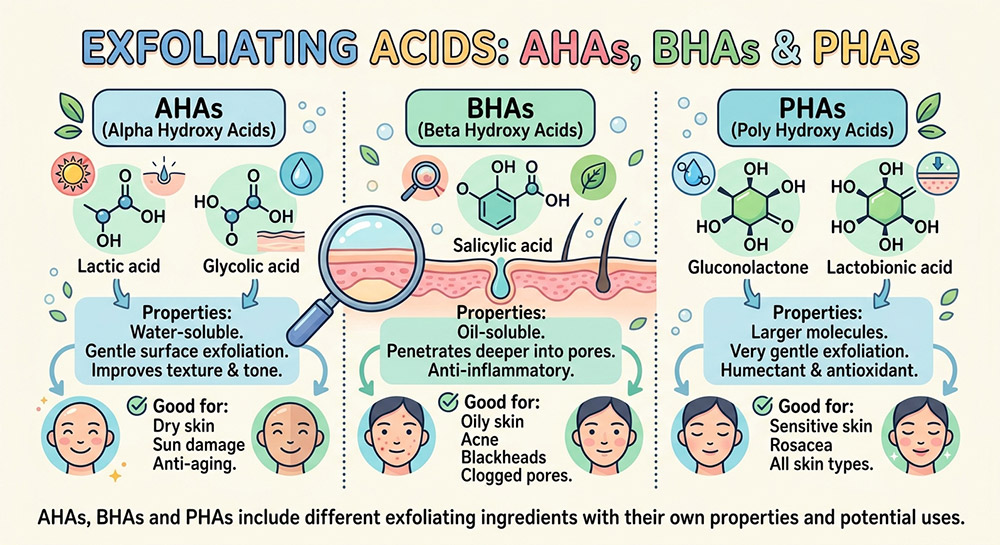
AHAs, BHAs and PHAs include different exfoliating ingredients with their own properties and potential uses.
How AHA, BHA and PHA Ingredients Work
All three groups can be used to exfoliate the skin, but differences in solubility and molecular size affect how the ingredients behave. These characteristics help explain why certain acids are associated with different concerns, although the complete formulation remains important.
Comparison of Exfoliating Acid Groups Across Key Properties
| Property | AHA | BHA | PHA |
|---|---|---|---|
| Stands for | Alpha hydroxy acid | Beta hydroxy acid | Polyhydroxy acid |
| Common ingredients | Glycolic acid, lactic acid, mandelic acid | Salicylic acid | Gluconolactone, lactobionic acid |
| Solubility | Water-soluble | Oil-soluble | Water-soluble |
| Molecular size | Small to moderate | Small | Larger |
| Where it works | Skin surface | Skin surface and inside oily follicular openings | Mainly at the surface, more gradually |
| Often considered for | Rough texture, dullness, uneven-looking pigmentation | Oily or congested skin | Skin that tolerates other acids poorly |
| Tolerance note | Varies by individual acid and concentration | Can dry or irritate with frequent use | Often better tolerated, but not irritation-free |
The complete product formulation, including concentration, pH level, and delivery system, determines how an acid behaves on the skin, rather than the acid group alone.
Alpha Hydroxy Acids (AHAs)
AHAs are water-soluble and include glycolic, lactic and mandelic acid. They are used in formulations intended to address concerns such as rough surface texture, dullness or uneven-looking pigmentation. The individual acids vary in molecular size, which can affect how readily they penetrate and how well they are tolerated.
Beta Hydroxy Acids (BHAs)
Salicylic acid is oil-soluble, allowing it to work within oily material around follicular openings as well as at the skin’s surface. This is why it may be considered for oily or congested skin, although it can still cause dryness and irritation when the formulation is unsuitable or used too frequently.
Polyhydroxy Acids (PHAs)
PHAs such as gluconolactone and lactobionic acid have a larger molecular structure than many AHAs. They generally penetrate more gradually and may be better tolerated in selected formulations, but they can still irritate skin that is already sensitive or over-exfoliated.
Why Two AHAs Can Affect the Skin Differently
Glycolic, lactic and mandelic acid are all AHAs, but their molecular sizes and chemical properties are not identical. Glycolic acid has a molecular weight of around 76 Da, lactic acid around 90 Da, and mandelic acid around 152 Da, the smallest molecule generally penetrates most readily, which is exactly why the same concentration of each acid can behave differently on the skin.
Cosmetic, over-the-counter formulations are typically found at concentrations of around 5% to 10% and a pH of roughly 3.5 to 4.5, while professionally applied peels may use concentrations from 20% up to 70% at a lower pH, often below 3. A low pH at a modest percentage can be more active on the skin than a high percentage at a higher pH, which is why the concentration figure on a label does not tell the whole story. Your skin may therefore respond differently to each acid, even when the products appear to contain a similar concentration. The type of product matters too. A glycolic acid cleanser designed to remain on the skin briefly will not have the same effect as a professionally applied glycolic peel, even though the ingredient name is the same.
How Concentration and pH Affect an Acid Peel
The percentage printed on a product label is useful, but it does not provide a complete measure of strength. The pH affects how much of the acid is available in its active form, while the supporting ingredients and application method can also change how the skin responds.
The effect of an acid formulation depends on:
- The individual acid or combination of acids
- Its concentration and pH
- The product’s supporting ingredients
- The amount applied
- The number of layers used
- How long it remains on the skin
- How frequently it is used
- The current condition of the skin
Concentration is only one of several factors that determine how an exfoliating acid behaves on the skin.
Professional Chemical Peels and At-Home Acids
Professional chemical peels are applied according to a defined protocol. The practitioner can assess your skin, control the amount used and observe its response before completing or neutralising the treatment. For more on what happens during a professional peel, see our guide to how chemical peels work.
At-home acids are designed for consumer use, but they can still cause significant irritation when combined or applied too frequently. Problems can develop when several exfoliating products, retinoids and scrubs are used within the same routine, even when each product appears relatively mild on its own.
Does a Stronger Acid Produce a Better Result?
Not necessarily. A stronger formulation can cause more inflammation and require a longer recovery period without guaranteeing a more appropriate or noticeable improvement. Excessive irritation may also disrupt the skin barrier and increase the risk of post-inflammatory pigmentation.
The aim is to create enough exfoliation to address the intended concern without causing avoidable skin damage. A lack of stinging or visible peeling does not mean that a product has failed or that a higher concentration is required.
Signs You May Be Using Too Many Exfoliating Acids
Over-exfoliation can develop gradually, particularly when several acids and active products are being used together. The first sign is not always obvious peeling, as your skin may instead become increasingly tight, sensitive or difficult to manage.
Possible signs of over-exfoliation include:
- Persistent tightness or flaking
- Stinging when familiar products are applied
- Increased redness or itching
- New sensitivity to cleansing or moisturising
- A shiny but uncomfortable skin surface
- Breakouts developing alongside irritation
- Difficulty tolerating previously comfortable products
How Chemical Peel Ingredients Are Selected
Choosing an acid involves more than deciding whether your skin is dry, oily or sensitive. The concern being addressed, current skin barrier, previous reactions, pigmentation tendency and wider skincare routine all help determine which formulation may be appropriate.
At Prophile Clinics, the individual acid is considered as part of the complete peel formulation. If your skin is already inflamed or reactive, allowing it to settle may be more appropriate than introducing further exfoliation.
What Matters When Comparing AHA, BHA and PHA Peels
Knowing whether a product contains an AHA, BHA, or PHA provides useful information, but it does not tell you everything about how the peel will work. The individual ingredient, concentration, pH, supporting formulation and application protocol all contribute to its effect.
This is why two products containing the same acid can feel and behave differently. The right choice depends on the concern being treated and what your skin can tolerate, rather than the most familiar ingredient or the highest percentage available.
Book a Skin Consultation at Prophile Clinics
To book an appointment, please call us on +61 485 960 001, email admin@prophileclinics.com.au or use the online booking form below.
AHA, BHA and PHA FAQs
Can AHAs and BHAs be used in the same formulation?
Yes, some formulations combine more than one acid to create a particular exfoliating effect. Combining them is not automatically better, and the total strength and potential for irritation still need to be considered.
Are PHAs completely non-irritating?
No. PHAs may be better tolerated in certain formulations, but they can still cause stinging, dryness or irritation. Skin condition, concentration and frequency of use remain relevant.
Which acid is best for pigmentation?
Selected AHAs may be included in treatments for some forms of uneven pigmentation, but the cause of the colour change must be established first. Melasma, post-inflammatory pigmentation and sun-related changes do not necessarily respond in the same way.
Can BHA be used on dry skin?
Skin type alone does not determine whether salicylic acid is appropriate. A BHA may be considered for a specific concern in otherwise dry skin, but the formulation and wider routine must avoid worsening dryness or barrier disruption.
Can exfoliating acids make visible pores smaller?
Acids may reduce congestion and improve the surface around follicular openings, which can make pores appear less noticeable. They cannot permanently remove pores or change the fact that pore visibility is partly determined by genetics and skin structure.
Is it safe to use an exfoliating acid every day?
That depends on the ingredient, formulation, strength and individual skin response. Daily use may be appropriate for some low-strength products but excessive for others, particularly when several active ingredients are combined.
Do AHAs and BHAs increase sun sensitivity?
Some exfoliating acids can make the skin more vulnerable to ultraviolet exposure, particularly when irritation or peeling is present. Sun protection is therefore important while using acids and recovering from a professional peel.
Can exfoliating acids be used during pregnancy?
The answer depends on the ingredient, concentration, treatment type and individual circumstances. Pregnancy should be discussed with the practitioner and relevant healthcare professional before starting a new acid product or undergoing a peel.
Can I use acids if my skin barrier is damaged?
It is generally sensible to address active irritation before adding further exfoliation. Persistent stinging, flaking and reactivity may indicate that your skin needs a simpler approach and appropriate assessment rather than a stronger acid.
Why can two glycolic acid products feel different?
Products containing the same percentage of glycolic acid may have different pH levels, supporting ingredients and intended contact times. These differences can affect penetration, irritation and the overall way the product behaves on your skin.

August 25, 2026
August 18, 2026
August 11, 2026
August 4, 2026
July 22, 2026
 Online Marketing For Doctors

